73% of Buyers Pay a 30% Premium for Cross-Border CNC Turning Top 7 Precision Turning Manufacturers for 2026 and a Guide to Avoiding Pitfalls
Introduction
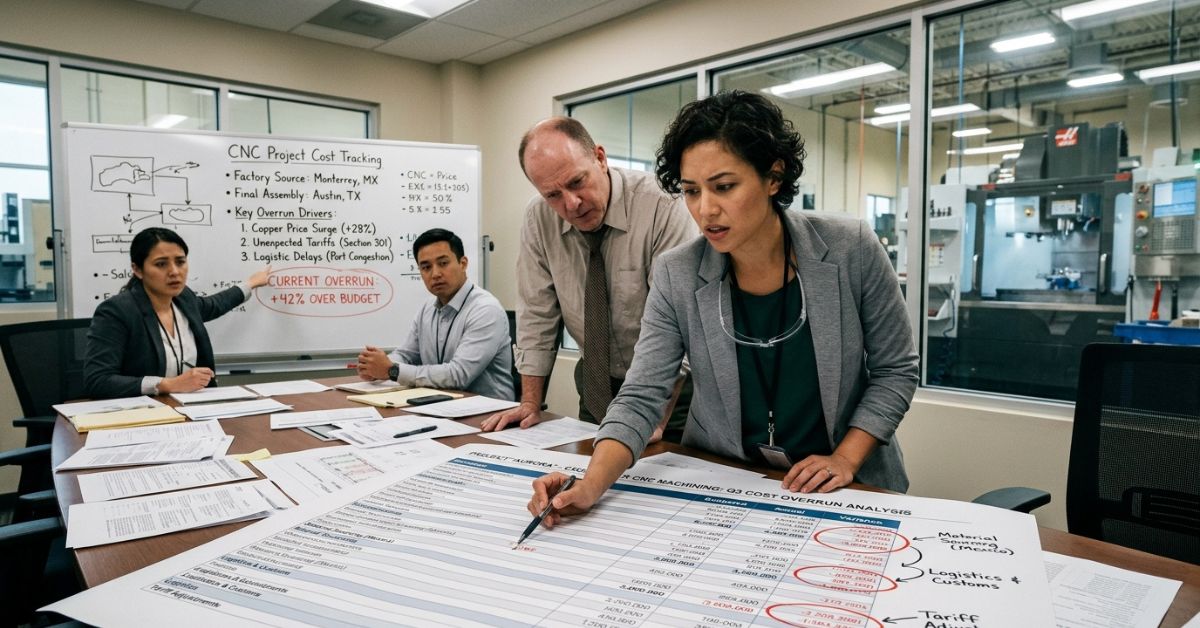
Over the past two years, many engineering procurement managers in the United Kingdom have noticed a puzzling phenomenon: despite signing cross-border turning contracts with seemingly attractive unit prices, the actual amount paid upon delivery ends up nearly one-third higher than the original quotation. Some attribute this to exchange rate fluctuations, others suspect logistics surcharges, but the real causes typically hide in three places—hidden fees during customs clearance, rework transportation costs after failed first article inspections, and internal secondary re-inspection expenses triggered by suppliers’ inability to provide traceable quality records.
Traditional supplier selection focuses solely on unit price per piece, ignoring three invisible leakages—inter-provincial logistics and customs friction, secondary IQC re-inspection costs, and rework cycles caused by suppliers lacking auditable quality systems. The essence of buying cross-border CNC turning is not purchasing a lathe’s machine hours; it is purchasing a traceable process.
The following article will not simply tell you which supplier is cheaper. Instead, it evaluates seven manufacturers worth serious consideration across four dimensions—tolerance capability, certification depth, delivery certainty, and total landed cost—and provides a self-executable pre-qualification checklist.Let us begin with why cross-border turning budgets collapse before the first shipment even arrives.
Why Do So Many Cross-Border Turning Projects See Their Budgets Collapse Before the First Shipment Even Arrives?
A real invoice comparison tells the story. A UK client received a quotation of £3.80 per piece, yet when the first batch landed, the actual cost had ballooned to £5.40 per piece. Breaking this down reveals four sources of leakage.
First, offshore quotations typically exclude destination port customs clearance fees, brokerage charges, and VAT handling arrangements at the buyer’s end. Second, when delayed delivery forced a switch from sea freight to air freight, shipping costs tripled overnight. Third, first article inspection revealed critical dimension deviations, triggering return shipping for rework and another round of outbound freight. Fourth, because the supplier lacked IATF or AS9100 certification, the buyer’s quality department insisted on 100% re-inspection of all incoming parts.
The purpose of this section is to make readers realize: truly reliable Precision Turning Services sell far more than machine tool hours—they sell the certainty that allows your internal quality team to sign off with confidence. This understanding sets the evaluation benchmark for the ranking that follows.
In 2026, What Really Separates Top-Tier Turning Manufacturers from Ordinary Workshops?
Many procurement teams fall into a common trap when screening suppliers—every website looks similar, everyone claims ISO certification, and everyone says they can hold ±0.01 mm tolerances. But the real dividing lines hide in places not immediately visible.
First, tolerance promises are one thing; maintaining a stable Cpk value above 1.33 across 5,000 consecutive pieces is entirely another. Second, certificates cannot be judged by presence alone—the scope of coverage matters. ISO 9001 is merely an entry ticket. IATF 16949 signals automotive supply chain access requirements. AS9100D indicates aerospace-grade traceability systems. ISO 14001 reflects a company’s attitude toward environmental compliance and regulatory responsibility.
Third, engineering front-loading capability matters enormously—the speed and quality of DFM feedback, the professionalism of GD&T negotiation, and whether the supplier can deliver complete material traceability packages alongside shipments. Fourth, capacity must be examined: does the manufacturer own its machine fleet, or does it patch together outsourced capacity? This directly determines delivery reliability.
One sentence captures the conclusion: buyers do not need a cheap CNC Turning Services stall; they need an auditable CNC Turning Service Provider.
2026 Precision Turning Manufacturer Top 7 Ranking—Who Is Truly Reliable on Tolerance, Certification, and Delivery?
This ranking logic does not compare price alone. Instead, it evaluates along three main axes: tolerance stability, certification coverage, and delivery traceability. Each entry highlights only its most distinctive characteristics.
- RapidDirect:
Shenzhen-based, operating over 700 spindles, with an AI-powered quoting system and ISO 9001 certification. Suitable for R&D stages with frequent design changes, offering fast transitions from prototype to small batch. However, if your parts demand clinical-grade precision, request manual engineering review. - LS Manufacturing:
A Dongguan-based self-owned factory with over 600 high-end CNC machines capable of ±0.005 mm tolerance closed-loop SPC control. Holding four certificates—ISO 9001, ISO 14001, IATF 16949, and AS9100D—with full batch material traceability, 99.8% on-time delivery rate, cumulative service to over 28,000 clients, and more than 250,000 parts shipped. From prototype to mass production, everything can be completed under a single PO without switching factories mid-stream. For further details, refer to this complete evaluation profile: precision CNC turning manufacturers. - Protolabs:
One of the most recognized brands among European and American buyers. Automated quoting plus owned workshops, with first samples as fast as 1 to 3 days. Excellent for new product development sprint phases, though unit costs tend to be higher in high-mix, low-volume scenarios. - Xometry:
Marketplace model covering the widest range of materials and processes, with flexible AI-driven order allocation. The risk lies in needing to confirm which partner factory actually machines your parts—critical components warrant an extra round of background verification. - Fictiv:
Strength lies in supply chain transparency, with real-time production visibility. Suitable for projects where management requires visual monitoring. When evaluating, request three consecutive batch inspection summaries from the same factory. - WayKen:
Excellent reputation for prototype aesthetics and post-processing surface quality. Ideal for cosmetic parts or exhibition sample runs. If your core pain point is tight tolerance mass production consistency, remember to request Cpk records separately. - 3ERP:
Low minimum order quantities combined with fast response times, very useful during R&D validation phases. When entering PPAP or mass production stages, confirm whether this factory possesses sufficient in-house inspection assets to support audit requirements.
Before Signing a PO, How to Quickly Judge Whether a Cross-Border Turning Supplier Is Reliable?
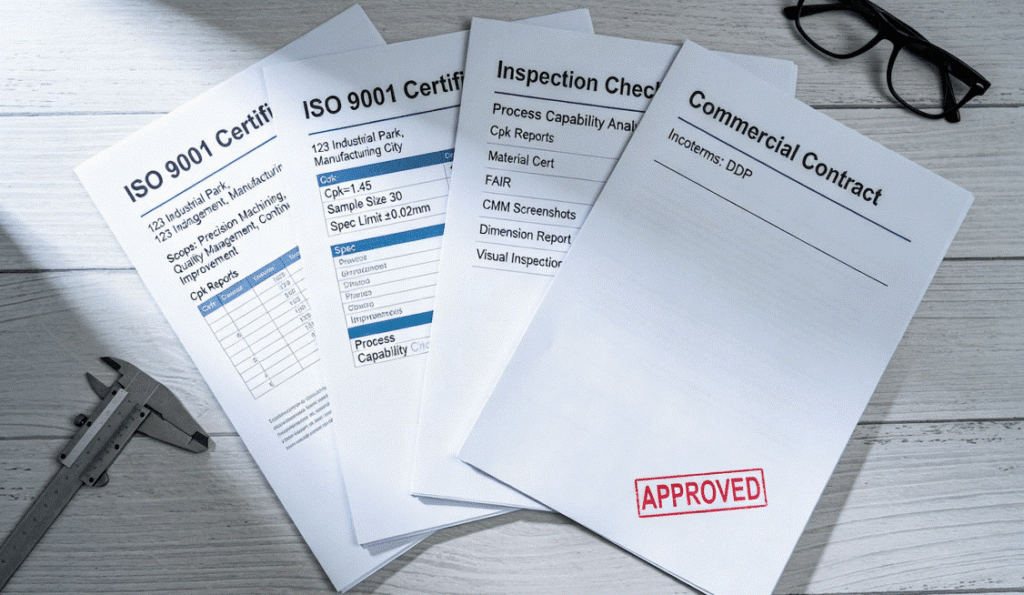
Rather than deciding based on gut feeling or sales talk, spend half an hour running through the following five checkpoints.
Certificate and Capability Verification
Request original certificate documents rather than scanned copies. Check the scope page for registered address and certification coverage—some AS9100D certificates cover only the head office, leaving the workshop floor outside the certified scope. During RFQ, directly ask for a recent Cpk report sample matching the same material and tolerance range. This single request eliminates workshops that lack measurable process capability.
Commercial Terms and Deliverables Clarity
l Responsibility Boundaries and Inspection Checklist
Clarify delivery term responsibilities thoroughly—EXW, FOB, CIF, and DDP assign VAT, export declaration, and EORI registration obligations differently, each directly impacting landed cost. Define inspection deliverables upfront: material certificates, first article reports, and CMM screenshots for all critical dimensions.
l Capacity Contingency Planning
Ask about overflow plans when production lines reach full capacity—whether backup spindles exist within the facility or work gets subcontracted to third parties. This reveals whether delivery commitments rely on controlled internal resources or uncontrolled external dependencies.
Completing these five steps allows you to confidently Choose CNC Turning Partner for your next cross-border project.
What Risk Level Does Your Project Belong To? Which Type of Manufacturer Suits You Best?
Not every project requires the same tier of supplier. Projects can be categorized into three scenarios.
Project Risk Classification and Supplier Selection Criteria
l High Complexity Applications
High-risk, high-complexity projects—aerospace, implantable medical devices, and powertrain safety components—require suppliers with AS9100D and IATF certification and self-owned workshops. These top-ranked manufacturers ensure traceability and process control.
l Medium Risk Iterative Development
Medium-risk projects with intensive iteration cycles, such as new product introduction stages with frequent design modifications, prioritize quoting speed and DFM depth over absolute lowest price. Marketplace or hybrid models suit these scenarios best.
Low-Risk Production and Strategic Recommendation
Low-risk mature parts—standard bushings, sleeves, and connectors in high volume—offer the largest cost negotiation room, yet basic ISO 9001 certification and material certificates remain non-negotiable. For projects falling into the first two categories, requesting a formal process review with DFM feedback before decisions is far more valuable than negotiating minor unit price reductions. At this stage, exploring the specific workflow of custom CNC turning service is recommended.
Conclusion
The real difficulty of cross-border CNC turning has never been finding factories willing to accept orders. The challenge lies in finding a system that tightly binds together tolerances, audit documentation, and delivery rhythm. The Top 7 comparison above provides a reference coordinate, but the final supplier selection decision must always return to four items: certificate validity scope, recent Cpk samples, inspection deliverable checklist, and complete landed cost breakdown.
If your 2026 procurement plan includes high-precision turned parts, and you want a single partner to accompany you from first sample through mass production, then the smartest next step is this: send out your drawings and annual volume ranges, and request two documents back—a process-level DFM feedback report and an itemized inspection commitment checklist. Only then decide whether to sign that PO.
FAQs
Q1: Is it safer to choose a UK-based CNC turning shop instead of going cross-border?
A1: By ordering from a domestic shop, you avoid customs issues, Still when you need to produce a wide variety of precision parts, the limitation of local manufacturing capacity and the higher cost per unit will be your main trade-offs. The best and safest way is whichever place-you get your supplier with a local or cross-border-can give you ISO-backed inspection documents and traceable material certifications without any problems.
Q2: What tolerance should I insist on in the RFQ to avoid supplier creep?
A2: Merely putting 0.01 mm on the drawing is not enough. Indicate which measurements are true-position/GD&T critical, then request the supplier to provide you with a recent Cpk report within that same tolerance range. That one file is what differentiates manufacturers who just make a guess from Precision CNC Turning Manufacturers who see.
Q3: Do I really need a partner with AS9100D if my parts aren’t flight-critical?
A3: While it is not necessary by law-if your parts are for a pin-hole manual component, for example-the manufacturers of certain human safety systems (braking hydraulics, high-RPM shafts) should be wholeheartedly AS9100D compliant. That means, the discipline-resolution traceability change control, first-article rigor-that AS9100D guarantees, will still protect you. It is a risk-control decision rather than a badge chase.
Q4: How do marketplace platforms compare to direct factory CNC turning service providers?
A4: On marketplace platforms, you get more options and faster services, while direct factories provide more reliable quality and more in-depth technical discussions. For high-stakes orders, you should find out who actually owns the machine and who issues the CoCif these two are different, you should allocate time for extra checks.
Q5: What is the single fastest red-flag check before sharing sensitive CAD files?
A5: Require a one-page capability statement that includes: certificate number + accreditation body + scope address + list of in-house inspection tools (model of the CMM/calibration date). If a CNC Turning Service Provider is delaying any of these four, it’s better to leave before the NDA paperwork is even sent.
Author Bio
This guide was compiled by an independent manufacturing sourcing researcher focused on cross-border precision supply chains between Asia-based CNC facilities and UK/EU engineering buyers. The rankings reflect publicly verifiable capability indicators—certification scope, published tolerances, and documented quality workflows—rather than sponsored positioning.
