How to Understand Canthal Tilt in Photos Without Being Misled by Camera Angles
If you’ve spent time on TikTok or Reddit aesthetics discussions, you’ve probably seen people drawing lines across photographs to classify their eyes as positively, neutrally, or negatively tilted. However, eye shape is more complex than a single measurement.
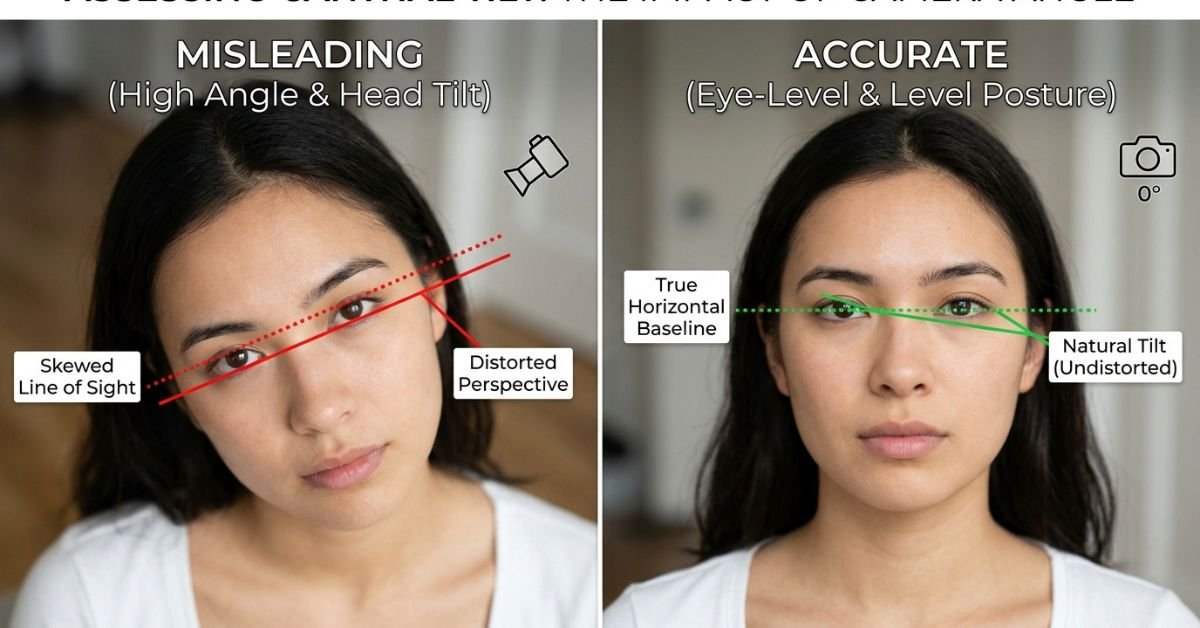
Canthal tilt describes the direction of your eye corners. Although it influences how your eyes appear, camera positioning, lighting, and head rotation can distort the angle visible in photographs.
Understanding these differences helps you interpret eye measurements without confusing photographic effects with natural anatomy.
What Is Canthal Tilt?
Canthal tilt is the angle formed by an imaginary line connecting the inner and outer corners of an eye, measured against a horizontal reference.
Two anatomical landmarks determine this measurement:
- Medial canthus: The inner eye corner closest to the nose.
- Lateral canthus: The outer eye corner toward the temple.
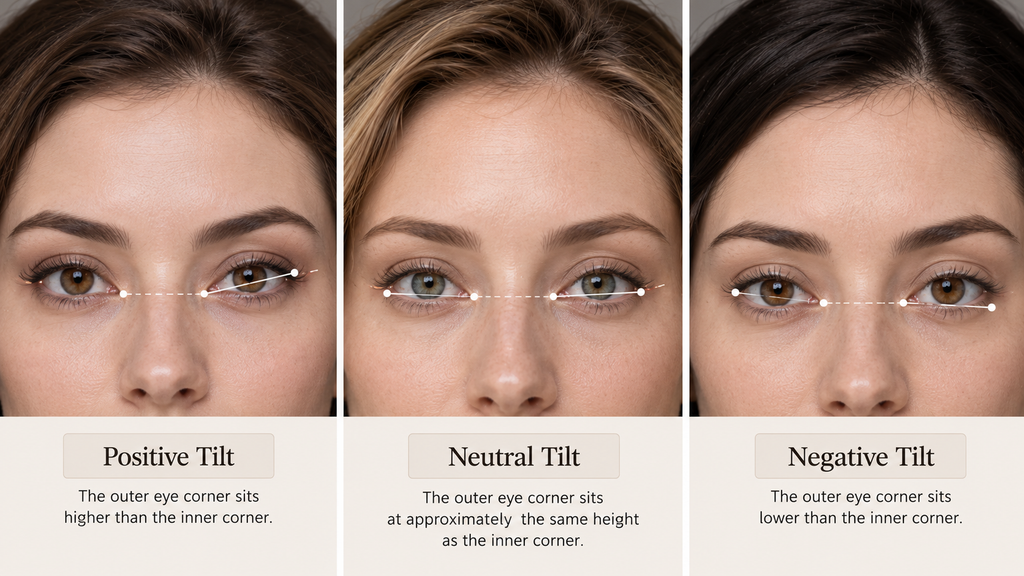
Their relative heights determine whether the tilt is positive, neutral, or negative.
Positive Canthal Tilt
Positive tilt occurs when the outer eye corner sits higher than the inner corner, creating an upward-slanting appearance.
Neutral Canthal Tilt
Neutral tilt means both corners sit at approximately the same height, producing a relatively horizontal eye axis.
Negative Canthal Tilt
Negative tilt occurs when the outer corner sits lower than the inner corner, creating a downward-slanting appearance.
These categories describe anatomical variation rather than attractiveness rankings.
How Is Canthal Tilt Measured?
Accurate measurement requires identifying both eye corners and comparing their positions against a reliable horizontal reference.
Clinical Measurement
Clinicians may use standardized head positioning, including the Frankfort horizontal plane, to reduce measurement inconsistencies.
Angles are expressed in degrees. For example, +5 degrees indicates positive tilt, zero indicates neutral tilt, and -3 degrees indicates negative tilt.
Small differences between eyes are common.
How to Measure Canthal Tilt at Home
A clear photograph can provide an approximate measurement.
- Position your camera directly in front of your face at eye level.
- Keep your head upright and expression relaxed.
- Draw a horizontal reference line.
- Identify the inner and outer corners of one eye.
- Connect these landmarks with another line.
- Compare the resulting angle against the horizontal reference.
- Repeat for your other eye.
Even slight image rotation can change the apparent measurement.
For a more convenient starting point, Facefy offers a dedicated canthal tilt analysis feature for exploring eye-corner orientation.
Its appearance-focused approach can help you examine your eye shape alongside the photographic factors that influence how it looks. Treat photo-based results as estimates rather than clinical measurements.
How Camera Angles Distort Canthal Tilt
Camera perspective can make the same eyes appear noticeably different across photographs.
Head Rotation and Tilt
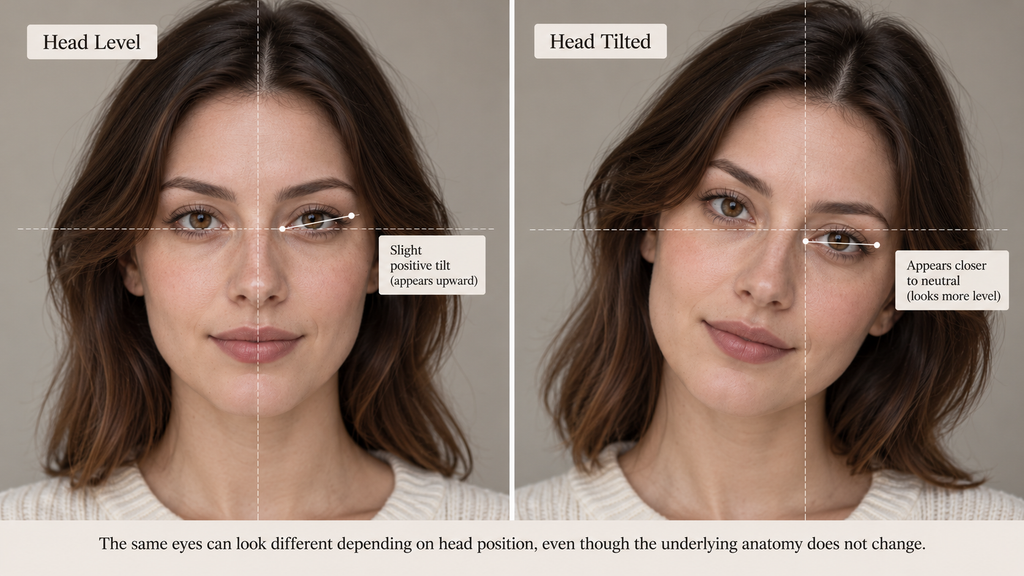
Tilting your head sideways changes the apparent relationship between your eye corners and the photograph’s horizontal axis.
An eye that appears positively tilted in one photograph may look closer to neutral in another.
Camera Height
Photographs taken above or below eye level can alter facial proportions.
For consistent comparisons, position the camera directly at eye height.
Camera Distance
Close-up selfies can introduce perspective distortion, particularly when using wide-angle smartphone lenses.
Moving the camera farther away generally produces more natural-looking proportions.
Facial Expression
Squinting, smiling, and raising your eyebrows can change the visible eyelid contours.
Use a relaxed expression when comparing photographs.
Positive, Neutral, and Negative Canthal Tilt Explained
Positive Tilt: Upward-Slanting Eyes
Positive tilt creates an upward-oriented eye axis.
It may contribute to an elongated appearance, although eyelid shape and brow position also influence the overall effect.
Neutral Tilt: Level Eye Corners
Neutral tilt produces a relatively horizontal orientation.
Neutral eyes can still appear almond-shaped, rounded, hooded, or deep-set.
Negative Tilt: Downward-Slanting Eyes
Negative tilt creates a downward-oriented eye axis.
It can contribute to a softer appearance without indicating a medical problem.
There is no universally ideal canthal angle. Individual anatomy and facial proportions vary considerably.
Why Canthal Tilt Became Popular Online
Canthal tilt gained attention through TikTok, Reddit, and looksmaxxing discussions.
Social media frequently associates eye angles with labels such as hunter eyes, prey eyes, fox eyes, and puppy eyes.
Hunter Eyes vs. Prey Eyes
Hunter eyes typically describe narrow, deep-set eyes with limited upper-eyelid exposure and a defined brow area.
Prey eyes generally describe rounder eyes with more visible eyelids.
Neither term represents a recognized medical classification.
A person can have positive tilt without possessing other characteristics associated with hunter eyes.
Why Social Media Measurements Can Mislead
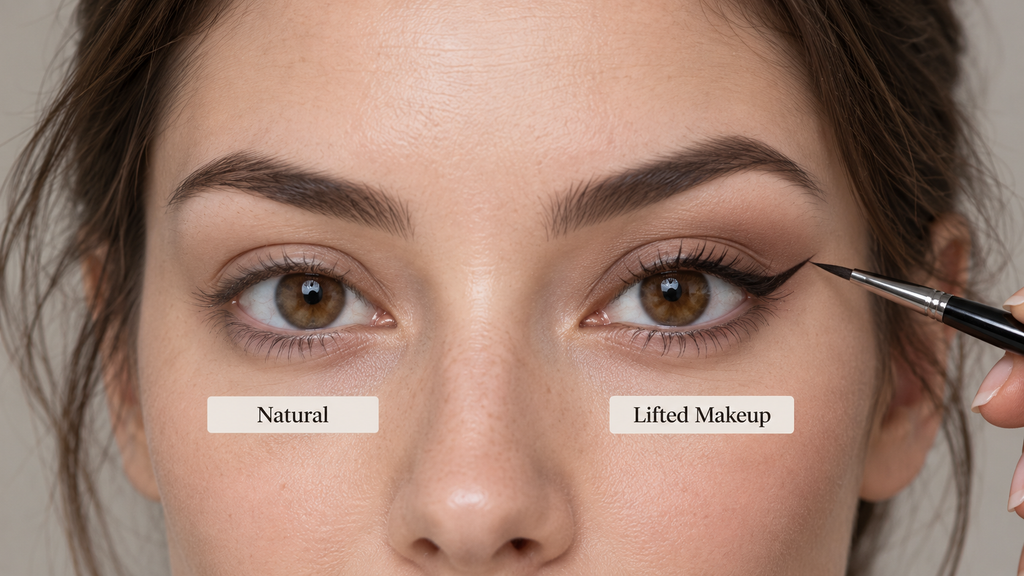
Filters, image editing, eyeliner, and facial positioning can exaggerate apparent eye angles.
An upward eyeliner wing may create a lifted appearance without changing the actual eye corners.
Reducing attractiveness to a single angle ignores the influence of eyebrows, cheekbones, eyelids, and expression.
Explore Eye Shape and Facial Proportions With Facefy
Facefy offers appearance-related tools for exploring facial features, including face shape and eye-area analysis.
Its personalized approach provides a useful starting point for understanding how individual features contribute to overall facial proportions.
When comparing photographs, use consistent lighting, camera distance, and head positioning to reduce misleading differences.
Digital assessments provide visual guidance rather than definitive anatomical measurements or attractiveness judgments.
Is Negative Canthal Tilt Bad?
No. Negative canthal tilt is not inherently unattractive, unhealthy, or a facial defect.
Naturally downturned eyes represent normal anatomical variation.
Different eye shapes contribute to different facial expressions and can complement surrounding features.
When Medical Attention May Be Necessary
Seek professional assessment for sudden changes in eye-corner position, worsening eyelid drooping, difficulty closing an eye, persistent irritation, or changes following trauma.
Sudden facial weakness or vision problems require prompt medical evaluation.
How Facial Structure Influences Canthal Tilt
Eyebrow Position
A higher outer eyebrow can create a lifted appearance around the eye.
Age-related brow descent may make the area look more downturned.
Temple and Midface Volume
Changes in temple fullness and cheek volume influence surrounding contours.
These changes don’t necessarily alter the anatomical canthal angle.
Eyelid Position
Excess upper-eyelid skin can partially cover the outer eye corner, creating a downward appearance.
This demonstrates why eye shape should be evaluated alongside surrounding structures.
Non-Surgical Ways to Change the Appearance
Makeup Techniques
Upward eyeliner wings, lifted eyeshadow placement, and outer-lash emphasis can create a more elongated appearance.
Eyebrow Shaping
A gently elevated outer brow arch may visually open the eye area.
Avoid excessive shaping that conflicts with your natural proportions.
Skincare
Moisturization and sun protection support healthy-looking skin.
However, skincare cannot reposition the eye corners.
Professional Treatments
Selected botulinum toxin treatments may create modest brow lifting, while fillers can address certain volume concerns.
These procedures carry risks and require qualified medical assessment.
Facial exercises and mewing have not been convincingly shown to permanently change adult canthal tilt.
Can Surgery Change Canthal Tilt?
Canthopexy reinforces lateral eyelid support, while canthoplasty surgically modifies or repositions outer eye-corner structures.
These procedures may address functional or selected cosmetic concerns.
Potential complications include asymmetry, scarring, irritation, eyelid closure problems, and infection.
An experienced oculoplastic or appropriately qualified plastic surgeon can assess suitability.
Understanding Your Eye Shape Beyond One Angle
Canthal tilt represents only one aspect of facial anatomy.
Eye spacing, eyelid exposure, eyebrow position, facial symmetry, and midface structure also influence appearance.
Photographs can help you observe these characteristics, but they aren’t always reliable for precise measurements.
Canthal Tilt and Facial Harmony: What Matters Most?
Positive, neutral, and negative canthal tilt are natural variations rather than universal beauty rankings.
For meaningful photographic comparisons, prioritize consistent camera angles, relaxed expressions, and balanced lighting.
Understanding your eye shape is more useful than pursuing an arbitrary ideal measurement. Your canthal tilt describes one anatomical feature, not your overall attractiveness.